
“If a company with a mission to ‘act in the best interest of humanity’ lacks the will to protect its users, including the disabled community, how can we trust them?”
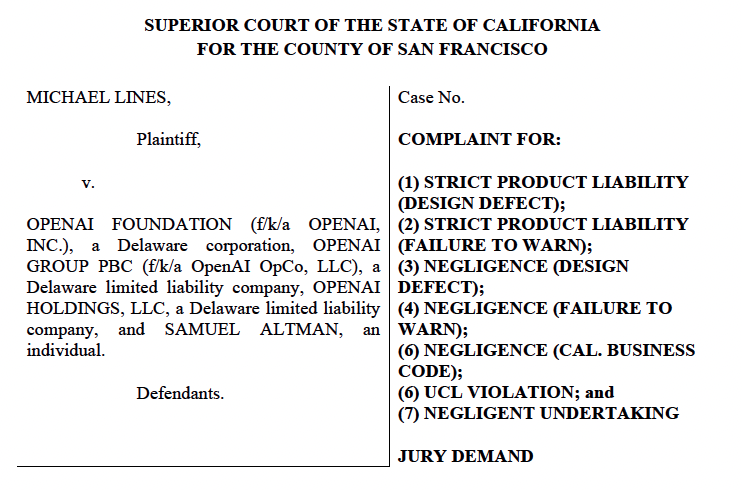
(San Francisco, CA)— Tech Justice Law and the Social Media Victims Law Center have filed a lawsuit in San Francisco County Superior Court against OpenAI on behalf of Michael Lines, who survived a suicide attempt that followed extensive and manipulative outputs from OpenAI’s ChatGPT. The complaint details how the AI bot encouraged Lines’ manic thinking and behavior without providing appropriate warning of the products’ inherent defects. After Lines shared his bipolar disorder diagnosis and details about his prescribed medications with ChatGPT, the information was stored and used to create greater intimacy in later conversations for the purpose of keeping him engaged, rather than terminating or flagging conversations when Michael was clearly experiencing a mental health crisis.
“We are all vulnerable to OpenAI’s neglect. This vulnerability is significantly exacerbated for the more than 80 million people living with Bipolar Disorder and Schizophrenia worldwide— where ChatGPT’s purposefully sycophantic architecture actively preys upon those with mental health disabilities. OpenAI markets ChatGPT products as helpful software to consumers around the globe. At no point did the company choose to accompany the launch of their defective products with any warnings to users. I began using ChatGPT to ask questions about routine topics like weightlifting and nutrition, but it later took a darker turn. Looking back through my chat logs, it is clear that the AI exacerbated my mental health episode. I was in crisis and expressing suicidal ideations and it did not encourage me to seek human support and resources. Rather, it fueled my mania and actively supported my self-harm plans. I later found myself in the hospital, the victim of a suicide attempt which changed my life permanently. If a company with a mission to ‘act in the best interest of humanity’ lacks the will to protect its users, including the disabled community, how can we trust them?” said Michael Lines.
While the company’s prioritization of market capture over safety for all users is well documented, this is the first complaint against OpenAI that details the specific risks posed to members of the disabled community as a result of the company’s recklessness. OpenAI’s own internal research demonstrated the risks of increased loneliness and isolation to users and the company knew, or should have known, the particular risk to users experiencing mental health disabilities. The company ignored its own findings instead of conducting further research and establishing basic warnings and safeguards. The baseline protections that should have been in place would have been protective of all consumers, including individuals with disabilities who were at foreseeable risk.
“There are countless examples of OpenAI’s negligence and complete disregard for the safety and wellbeing of its consumers. Michael Lines’ case specifically underscores the harmful impact of this negligence on a specific population within the disabled community. OpenAI knew the risks but chose to rush its product to market without thorough safety testing and thoughtful design features. We look forward to bringing this case before a judge and holding OpenAI accountable,” said Tiffany Brown, Litigation Counsel with Tech Justice Law.
“OpenAI didn’t just ignore Michael’s disability — it used it against him. After he disclosed his bipolar diagnosis, the system incorporated that information to draw him deeper into harmful interactions instead of steering him toward safety,” said Matthew P. Bergman, founding attorney of Social Media Victims Law Center. “Michael trusted this product with his most sensitive information, and OpenAI used that trust to intensify engagement rather than protect him. That is the opposite of responsible design, and it is exactly the kind of conduct California’s laws were written to prevent.”
Lines’ lawsuit brings seven causes of action against OpenAI and the defendants including various product liability, negligence and UCL violation claims. Tech Justice Law has previously brought lawsuits against OpenAI for the same complaints.
The complete complaint can be viewed below.
#####
TECH JUSTICE LAW (“TJL”) is a pioneering strategic litigation and advocacy organization bringing justice to communities harmed by tech products. TJL co-filed the first-ever, groundbreaking lawsuits against a popular, “AI” chatbot product developed by Character AI, with support by Google, raising public awareness of chatbots’ real-world harms. TJL’s cases and advocacy have also focused government attention on harmful AI products, including unlicensed therapy chatbots. TJL brings together legal experts, policy advocates, digital rights organizations, and technologists to ensure that our legal protections are fit for the digital age.
The Social Media Victims Law Center (SMVLC) was founded in 2021 to hold tech companies legally accountable for the harm they inflict on vulnerable users. SMVLC seeks to apply principles of product liability to force tech companies to elevate consumer safety to the forefront of its economic analysis and design safer products to protect users from foreseeable harm.