
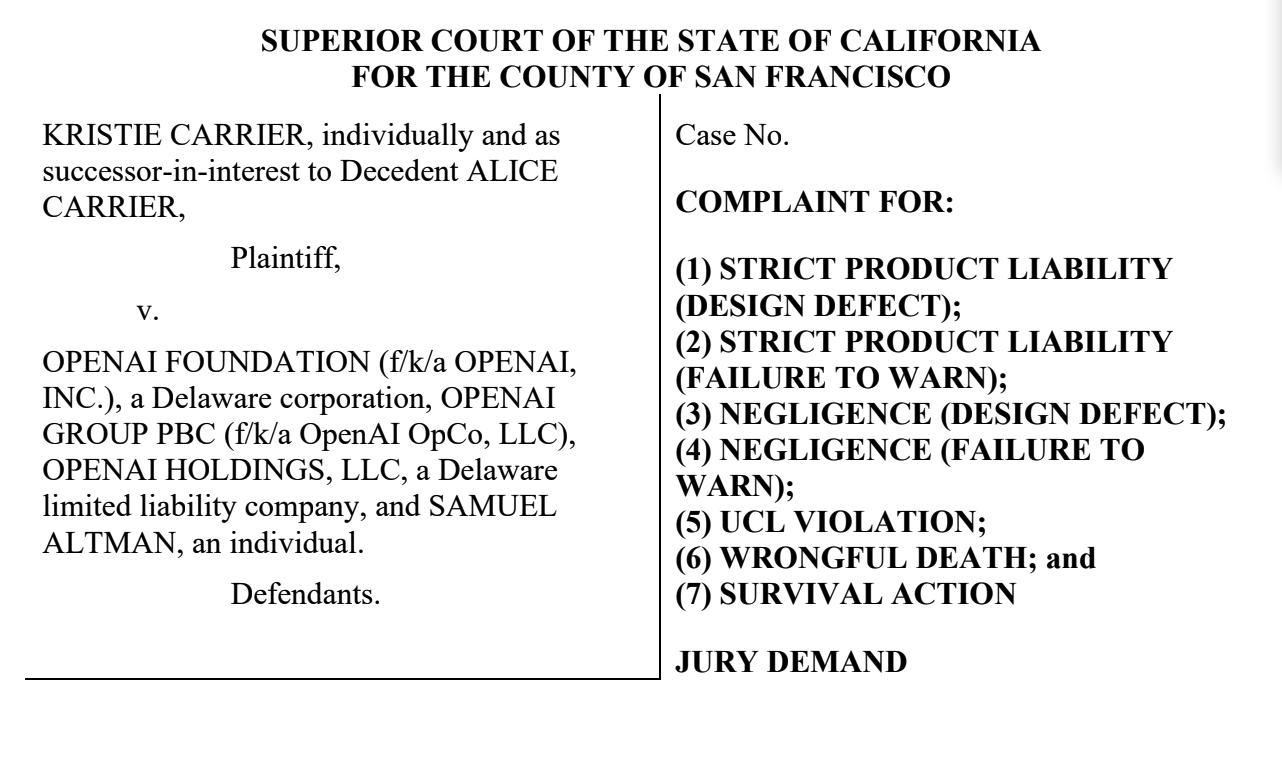
Tech Justice Law, Social Media Victims Law Center and Susman Godfrey have filed a lawsuit in San Francisco County Superior Court against OpenAI and Sam Altman on behalf of Kristie Carrier. The lawsuit alleges various legal claims grounded in product liability, negligence, wrongful death and unfair competition. The suit also requests an injunction requiring OpenAI to implement a range of safeguards by default for users. The lack of such safeguards, or even warnings regarding the risk of psychological dependence or other harms, is a direct result of OpenAI’s prioritization of rushed product development and growth over user safety.
“If a person came up to me, and they were clearly in distress and sharing their thoughts of suicide, I would be expected to help them, not encourage them to fixate on their depressive thoughts or isolate themselves. The same should be true of OpenAI. Instead, OpenAI has chosen to put out a product that was unsafe, and that they knew was unsafe but they did so without any concern for the consequences of their choices. Sam Altman can continue to go about his life normally, but my life is missing a child. This is unacceptable. Automatically stopping certain conversations or warning about the dangers of OpenAI products is just the minimum of what they can and must do. The first cars didn’t have seatbelts—those had to be added in to protect people. And if OpenAI doesn’t want to add in seatbelts, or be honest about the risks that come with using their products, I am ready to hold them accountable. I don’t want any other family to go through what we have, and OpenAI needs to change,” said Kristie Carrier.
Kristie Carrier’s daughter, Alice Carrier, died by suicide on July 2, 2025. As Kristie began to review her daughter’s devices, she was shocked to discover extensive ChatGPT conversations where Alice shared her suicidal thoughts in the months prior to her passing, with escalated exchanges in the days leading up to her death. These exchanges included discussing suicide methods and describing the feelings of isolation she was experiencing. Instead of automatically terminating these alarming conversations, flagging her account for human intervention, or refusing to engage with inquiries regarding self-harm or suicide, ChatGPT continued to encourage Alice’s engagement, resulting in her further isolation from her human support system and ultimately, suicide.
“As the complaint alleges, OpenAI’s deliberate design decisions led to this tragic suicide. Instead of providing help, OpenAI encouraged suicidal behavior. This lawsuit is about accountability for OpenAI’s actions,” said Justin Nelson, partner at Susman Godfrey.
Carrier’s complaint will join the JCCP 5341 coordinated proceeding, which has grouped 12 product liability and wrongful death lawsuits against OpenAI in San Francisco County Superior Court. Several other similar and recently filed cases are expected to be added to the JCCP 5341.
“OpenAI has been reckless in the design, marketing and launch of their products. Each loss of life, resulting from OpenAI’s actions, is an unimaginable tragedy. This case is no different, and demonstrates OpenAI’s flagrant disregard for the safety and wellbeing of its users. There are obvious safeguards that should have been in place and basic warnings included to inform consumers about the real risks they face when they engage with ChatGPT. That is the floor of what consumers should be able to expect from this industry, and we will continue to fight to hold OpenAI accountable,” said Tiffany Brown, Litigation Counsel, Tech Justice Law.
“OpenAI built a tool that can shape human behavior, yet failed to include fundamental safety measures in the rush to get ChatGPT 4.0 to market before its competitors could introduce similar products,” said Matthew P. Bergman, founding attorney of the Social Media Victims Law Center. “ChatGPT’s responses were not harmless glitches — they were the predictable result of releasing a powerful product without the safeguards needed to protect vulnerable users. When a system encourages or reinforces suicidal ideation, accountability is not optional—it is essential.”
#####
Susman Godfrey is an AmLaw 100, national law firm of more than 200 elite trial lawyers devoted exclusively to high-stakes litigation. The firm represents both plaintiffs and defendants across a wide spectrum of industries and complex disputes, bringing exceptional courtroom skill and strategic precision to every matter. Susman Godfrey is renowned for crafting bespoke fee arrangements—contingent, flat, hourly, or hybrid—tailored to the unique demands of each case and aligned with client objectives. In 2025, the firm was named Law Firm of the Year by The American Lawyer and has been repeatedly recognized as its National Boutique Litigation Firm of the Year. To learn more about the firm’s distinctive approach to winning the most consequential cases, visit www.susmangodfrey.com.
TECH JUSTICE LAW (“TJL”) is a pioneering strategic litigation and advocacy organization bringing justice to communities harmed by tech products. TJL co-filed the first-ever, groundbreaking lawsuits against a popular, “AI” chatbot product developed by Character AI, with support by Google, raising public awareness of chatbots’ real-world harms. TJL’s cases and advocacy have also focused government attention on harmful AI products, including unlicensed therapy chatbots. TJL brings together legal experts, policy advocates, digital rights organizations, and technologists to ensure that our legal protections are fit for the digital age.
The Social Media Victims Law Center (SMVLC) was founded in 2021 to hold tech companies legally accountable for the harm they inflict on vulnerable users. SMVLC seeks to apply principles of product liability to force tech companies to elevate consumer safety to the forefront of its economic analysis and design safer products to protect users from foreseeable harm.