
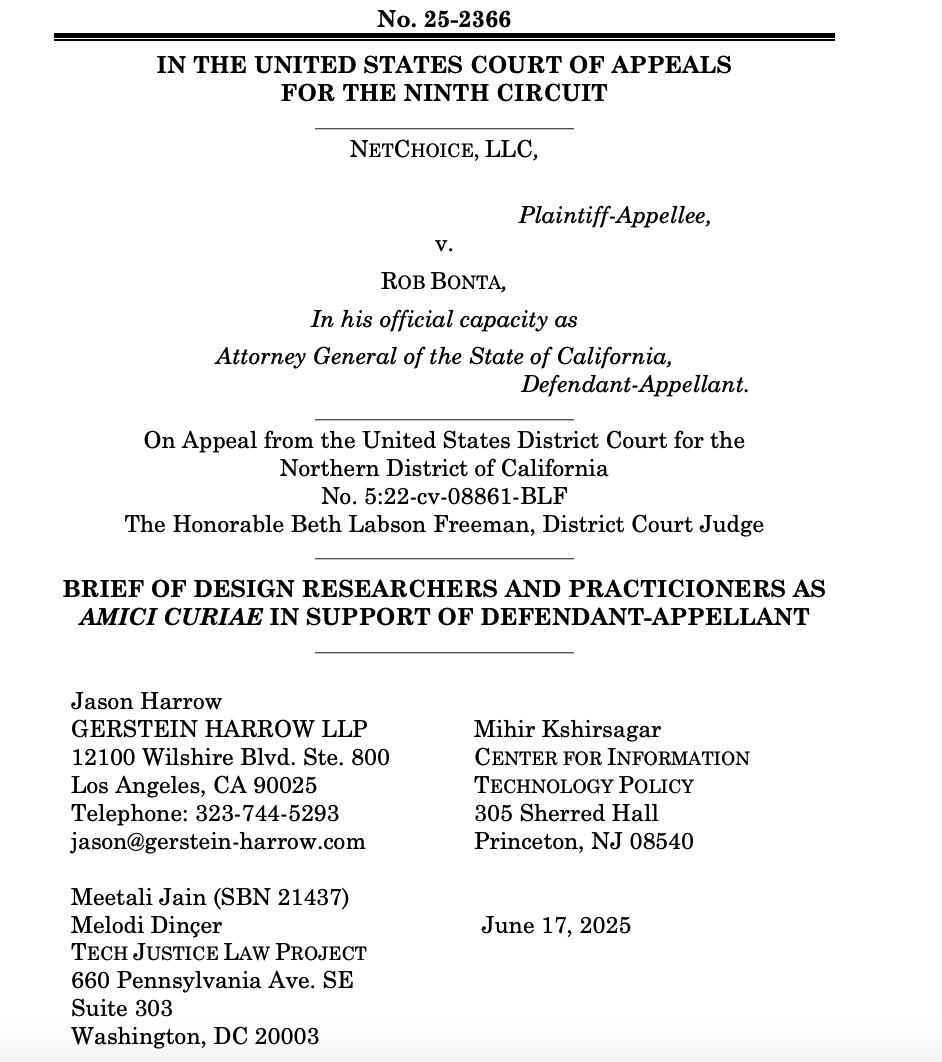
Washington, D.C. – On June 17, 2025, Tech Justice Law Project (TJLP), Princeton’s Center for Information Technology Policy (CITP), and 11 design scholars and practitioners filed an amicus brief supporting the California Attorney General in defending the California Age Appropriate Design Code Act (CAADC), an important law regulating how companies design and display tech platform(s) to prevent harm to kids and teens online. Among its requirements, the law requires businesses to conduct data protection impact assessments (DPIAs), provide privacy protections by default, and conduct age estimation. It also bans the use of dark patterns–manipulative design choices that mislead users and undermine their free will.
Although the AADC was signed into law back in 2022, tech industry group NetChoice has since been fighting to keep the law from being enforced by weaponizing the federal courts to argue the law violates the First Amendment.
Here is a timeline of the case, NetChoice v. Bonta:
- The AADC was enacted on September 15, 2022 and was set to go into effect July 1, 2024.
- NetChoice filed a Complaint on December 14, 2022. Among other things, NetChoice claims the law violates the First Amendment rights of regulated businesses and must be invalidated entirely. NetChoice sought a “preliminary injunction”, or an order from the judge halting the law’s enforcement.
- On September 18, 2023, the judge granted NetChoice’s preliminary injunction, finding the CAADC violated the First Amendment in its entirety based on an over-broad reading of the Amendment’s protections for online platforms.
- On August 16, 2024, the Ninth Circuit reversed the majority of the judge’s findings (except as to the law’s DPIA requirement), finding that NetChoice had failed to show that the law’s potentially unconstitutional applications outnumbered its constitutional ones, as required by the Supreme Court’s Moody decision.
- NetChoice went back to the district court and filed a second motion for a preliminary injunction on November 1, 2024. In January 2025, the same judge held a hearing with the attorneys, during which she further questioned NetChoice’s First Amendment arguments.
- In December 2024, TJLP and partners filed an amicus brief describing dark patterns, providing examples of how they harm kids and teens online, and arguing that the law’s ban does not raise First Amendment concerns.
- On March 13, 2025, the judge granted NetChoice’s second preliminary injunction request. Although she did not find NetChoice met its burden under Moody, she did find that much of the law–including the dark patterns ban–was too “vague” to be considered constitutional.
- On June 17, 2025, TJLP and partners filed a second amicus brief repeating the harms of dark patterns on kids and teens online and demonstrating that these harms are not only crystal clear to regulated companies–the harms are by design.
Read the full amicus brief here.